A tokenized decentralized platform needs an explanation of what its token does. “Community,” “utility,” and “AI” are not sufficient specifications. The design should identify a participant, an action, a rule, and a reason that the rule needs this mechanism rather than an ordinary account balance or invoice.
This guide is an engineering-oriented design review, not an investment recommendation or a forecast of token value. It uses a hypothetical compute marketplace to examine payment, resource access, governance, and operator incentives separately. The objective is to make the mechanism understandable enough to test and to expose the assumptions that would otherwise remain hidden behind a ticker symbol.
Write the service without the token first
Describe the basic exchange in ordinary language. A customer submits a task, an operator accepts it, the system checks the agreed completion condition, and the operator receives payment. Identify the information required at each step and the party authorized to resolve a dispute.
Then describe how the same service could work without a newly issued token. This comparison does not prove that a token is unnecessary. It establishes the baseline against which the additional mechanism must justify its complexity. Keep the alternative concrete enough that the team can compare operating responsibilities.
For every proposed token function, state the problem it solves. “Allows payment” is a starting point, not a complete justification. Explain why the chosen payment model improves the specified workflow and what new dependencies it creates for customers and operators.
Separate four possible roles
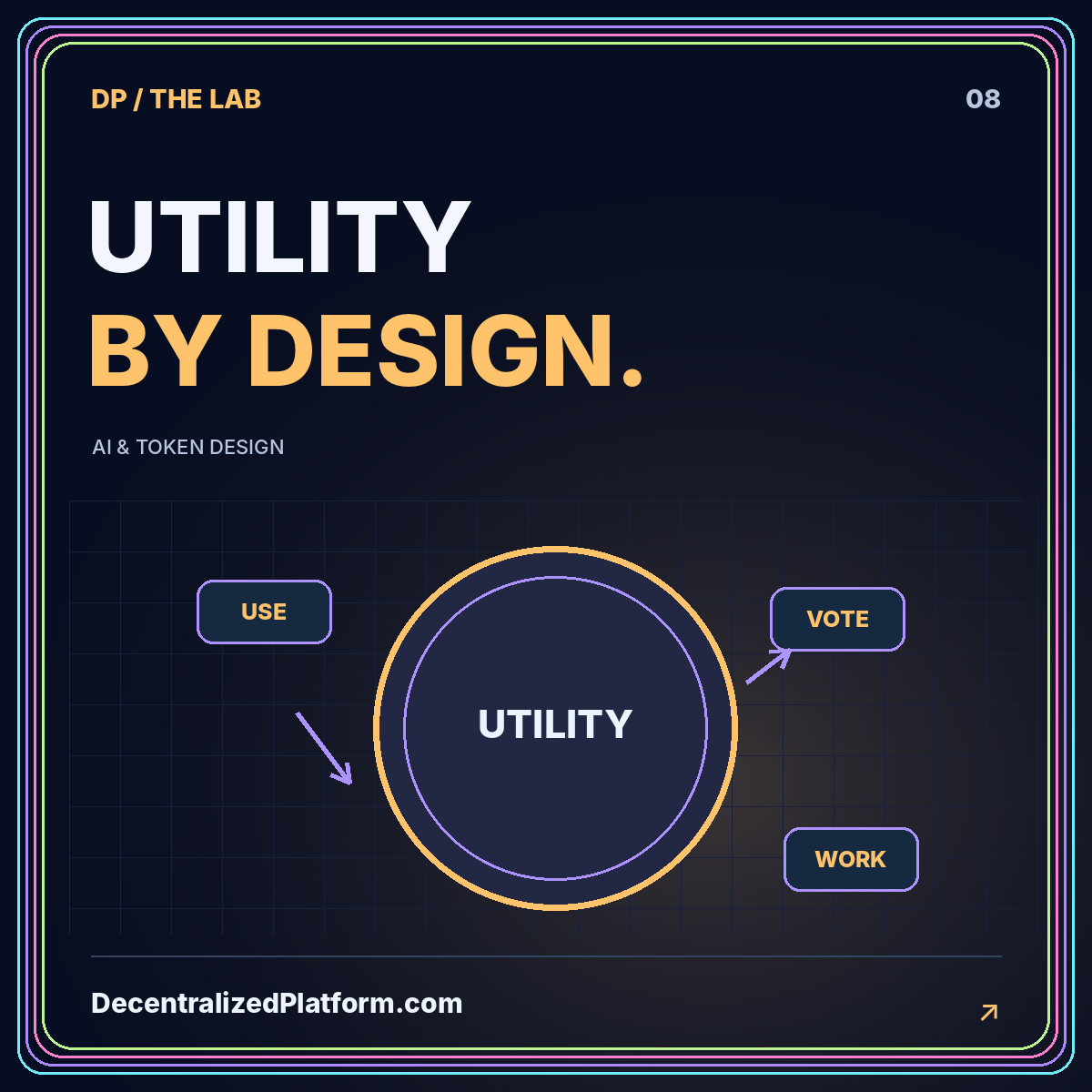
A token can be used for payment, permission to access a resource, voting weight, or an incentive arrangement. These are distinct roles. Combining them can create interactions that are difficult to understand, so document each role independently before deciding whether one instrument should carry them all.
For payment, specify the unit used to quote a job and the settlement process. For resource access, specify the entitlement and how it expires or is revoked. For voting, specify the decisions covered and the authority that enforces the result. For incentives, specify the behavior being rewarded and the evidence used to measure it.
Do not confuse an interface with a service promise
The ERC-20 token standard overview describes a common interface for fungible tokens, including balances, transfers, and allowances. Implementing that interface does not by itself establish compute capacity, effective governance, or a sustainable business model. Those belong to the surrounding application design.
Define the lifecycle of a service credit
For the hypothetical compute marketplace, map a customer's path from acquiring access to receiving an accepted result. Show when funds or credits are committed, when the operator can claim payment, and what happens when a task is cancelled or fails its acceptance condition.
Define edge cases before the happy path becomes production behavior. A task may time out after useful work has already occurred. A customer may submit an invalid input. An operator may return a result that is technically complete but fails the agreed evaluation. The design needs a dispute rule that participants can understand in advance.
Keep operational quantities distinct from market quantities. The amount of compute promised by a credit should be defined by the service specification, not inferred from a token's name. Where the resource entitlement varies, explain the rule governing that variation and how the customer sees it before committing.
Review administrative powers explicitly
List who can create additional units, pause transfers, modify service access, change an implementation, or redirect collected payments. Include powers held by a multisignature account, a governance contract, or an off-chain administrator. The mechanism's name does not replace an inventory of its authority.
For each power, identify the approval process and the circumstances in which it may be used. A pause mechanism can be useful during an incident but also creates an administrative dependency. A fixed implementation may reduce one kind of change authority while making error correction more difficult.
Test the uncomfortable scenario
Ask reviewers to walk through a disputed service result, a lost administrative credential, and an attempted unauthorized change. The aim is not to claim that every failure can be prevented. It is to make the decision path visible and to identify which assumptions still need an independent review.
Design incentives around observable work
Define what an operator must demonstrate to qualify for a reward. A self-reported task count is a different kind of evidence from an independently checked result. State who performs the check, how disputes are handled, and what it would cost an attacker to submit misleading evidence.
Consider how the measurement can be gamed in your hypothetical design. Rewarding raw job count may encourage splitting work into small tasks. Rewarding advertised capacity may encourage overstating available resources. These are proposed adversarial tests, not claims about any named project.
Separate bootstrapping incentives from ongoing service economics. A temporary allocation can motivate participation while obscuring whether customers are paying for useful work. Keep those flows distinct in internal reporting so the team can evaluate the mechanism without mistaking distribution activity for sustained demand.
Evaluate governance as an operating process
Specify which decisions belong in governance and which remain ordinary maintenance. Ask how a proposal becomes executable, how participants obtain the information needed to evaluate it, and how the result is communicated. A voting interface alone does not describe the complete process.
Record who can propose, vote, delegate, execute, and veto where those roles exist. Evaluate a proposal that receives little participation and one that creates a conflict between short-term rewards and long-term service capacity. The discussion should focus on the rules of your design rather than an assumption that voting always produces a good outcome.
Document the authority to change the governance process itself. Otherwise, reviewers may carefully evaluate one set of rules while missing the actor who can replace those rules. Connect this review to the decentralized platform architecture guide so administrative control remains visible.
Build a complete operating-cost model
Estimate the cost of running the service without assuming a favorable change in the token's market value. Include hardware, bandwidth, storage, verification, development, support, and incident handling. Mark each quantity as measured, quoted, or assumed.
For the compute example, compare customer payments with the cost of delivering accepted tasks. Keep promotional rewards separate. Test what happens when demand falls, a provider leaves, or the settlement mechanism becomes temporarily unavailable. These are stress scenarios for an operating design, not predictions about a market.
Before offering a real instrument, describe the intended entitlement, participant responsibilities, and dispute process clearly enough for qualified legal and tax review. Do not assume that a technical label settles those questions. Keep that review separate from the engineering prototype rather than treating a working contract as permission to launch a public offering.
Give users an understandable specification
Write a plain-language description of what the token does, what it does not do, and which administrative powers remain. Explain how users verify the intended contract or service endpoint without asking them to share private keys. Avoid suggesting that a token balance guarantees a particular investment outcome.
For an AI-related platform, distinguish payment for computation from the model's output units. The same word, token, can refer to a financial or service instrument and to pieces of text processed by a language model. The AI tokens topic guide keeps those meanings separate.
Conclusion: require a job description for the token
A credible token design names a concrete function, documents its authority, and tests the surrounding service. Start with the non-token baseline, separate payment from governance and incentives, and examine edge cases before making public promises. A standard interface is useful infrastructure, not a substitute for a complete mechanism.
Read the tokenized platform guide for the architecture layer and the AI compute evaluation guide for the underlying workload. The two should make sense independently before a token is used to connect them.