Token utility: give the mechanism a job description
Separate payment, resource access, governance, and incentives before adding a token to a hypothetical compute marketplace.
7 min readRead guide
Define the mechanism before the ticker. Separate payment, resource access, voting, and rewards from assumptions about investment value.
Describe the service as an exchange between participants: a request, accepted work, a verification rule, and a settlement process. Then describe a version using ordinary accounts or invoices. This baseline makes the extra complexity of a token visible.
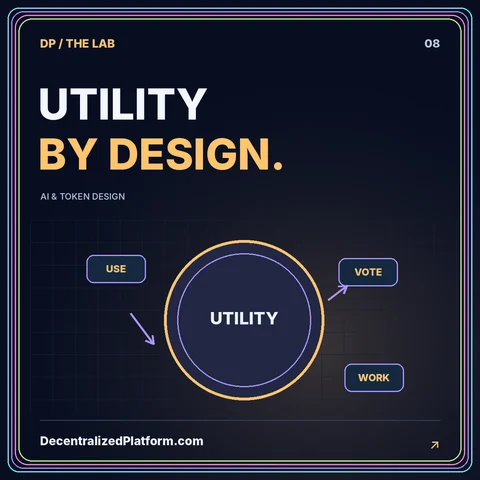
Give each proposed token function a concrete purpose. Resource access is not the same as governance, and a reward schedule is not evidence that customers receive useful work. Combining these roles deserves an explicit review of how their incentives interact.
The ERC-20 standard defines common operations for fungible tokens, such as transfers, balances, and allowances. It does not specify whether a surrounding marketplace has adequate capacity, whether its voting process works well, or whether a service entitlement will be honored.
For your design, document who may issue units, pause behavior, change implementations, and redirect payments. Include the power to alter governance rules themselves. A distributed participant list does not make administrative authority disappear.
Model the cost of delivering accepted work without assuming a favorable change in a token’s market value. Keep customer payments separate from temporary incentives. Review cancellation, failed work, disputes, and loss of settlement access.
Before a real offering, make the intended entitlement and participant obligations precise enough for qualified review. This guide is about mechanism design, not an investment recommendation. A functioning prototype should not be mistaken for a complete public-launch decision.
Reference pointEthereum: ERC-20 token standard. The checks here are a proposed review framework; verify your own operating environment.
Not by itself. Review operator selection, administrative powers, execution, and data availability independently of the payment instrument.
They can be designed separately. Evaluate whether combining them solves a real coordination problem or creates conflicts that the service would otherwise avoid.
Separate payment, resource access, governance, and incentives before adding a token to a hypothetical compute marketplace.
Design an AI pilot around reproducible workloads, data boundaries, useful output, and the complete cost of accepted tasks.