A decentralized platform can still fail in ordinary ways: an administrator loses access, a domain stops resolving, a release is removed from storage, or a server becomes unusable. Distribution helps only when the team knows how to use its alternatives. A recovery plan turns those alternatives from a diagram into a procedure that another person can execute.
This guide proposes a recovery exercise for a small public application or technical publication. It covers the interface, retained content, domain control, backend dependencies, and administrative access. The objective is not to promise uninterrupted service. It is to determine what can be restored, what the restoration depends on, and which user-facing functions remain unavailable until additional work is completed.
Define what recovery actually means
Start with the minimum useful service. For a documentation website, that may be read-only access to a known-good release. For a transaction application, a visible homepage is not enough; users may also need reliable state reads and a safe way to understand whether an action completed.
Write separate acceptance conditions for those functions. A public notice might be restored before an indexer or an administrative dashboard. Decide which limited operating states are acceptable and how the interface will describe them. Do not let the team declare success simply because one machine responds.
Set recovery objectives from the consequences of downtime and data loss. These are your planning targets, not guarantees supplied by a technology label. Record the assumptions behind them so a future operator can tell whether the planned resources and staffing still match the requirement.
Inventory the assets needed to rebuild
List source content, compiled releases, runtime configuration, deployment records, database exports where applicable, and essential media. Include the identifiers that connect these assets: repository revisions, release labels, IPFS root identifiers, contract addresses, and domain records.
Separate public artifacts from secrets. The website release may be suitable for broad replication, while credentials and private backups need controlled access. A single archive containing both is difficult to distribute safely and encourages the team to confuse publication with backup.
The NCSC's guidance on backing up critical cloud data emphasizes exporting essential information, understanding restoration, and keeping an independent copy rather than relying only on a cloud service's version history. Apply that distinction to your release artifacts and administrative records as well.
Map shared failure domains
Two copies are not meaningfully independent when the same compromised credential can delete both. Identify the accounts, organizations, networks, and administrative identities shared by your proposed alternatives. Label what you have verified and what remains uncertain.
For example, a primary host and a backup bucket might belong to different services but use the same single-sign-on account. Two gateway hostnames might route through one operator. These are hypothetical review cases, not a claim that every shared dependency is unacceptable. Their importance depends on the failure you are preparing for.
Separate recovery access from everyday access
Consider how an authorized maintainer reaches backups when the normal work account is unavailable. Keep the procedure protected and accessible to the people expected to use it. Do not store the only recovery instructions behind the exact account whose loss begins the exercise.
Test a clean rebuild in isolation
Use a staging environment with non-sensitive test data. Start without the original serving instance and follow the written instructions to recreate the required service. Record every missing file, undocumented assumption, and request for help from the original maintainer.
Verify the application rather than only the provisioning process. Check representative pages, images, authorization boundaries, and data reads. Where a recovered service depends on a particular software version or configuration, record that relationship in the rebuild instructions.
Avoid connecting a restored system to production immediately. First determine whether the artifact is the intended version and whether its credentials and data are appropriate for the environment. A recovery exercise should not accidentally publish old private data or overwrite the current service while testing a procedure.
Rehearse interface and content failover
Choose a previous known-good release and serve it through the alternate path. Open a deep route directly, test its assets, and confirm that essential navigation works. A homepage-only test can miss a release that relies on files still available only from the original host.
For an IPFS publication, verify that the retained root identifier can actually be retrieved while the usual delivery route is unavailable. A pin listed in an account is not a substitute for the retrieval exercise. Record which release versions remain available and which retention arrangements are required to keep them that way.
Communicate the exact release
Use a recognizable release label in the incident record and reader-facing notice where appropriate. This helps distinguish an intentional rollback from an unexplained stale page. Keep the label tied to the tested artifact so multiple operators do not unknowingly restore different versions.
Test naming and domain recovery separately
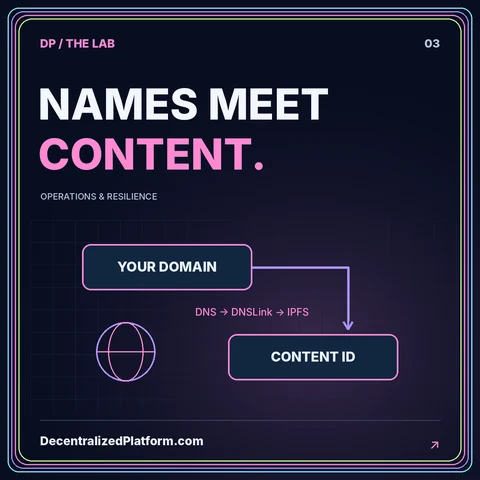
Document who can change DNS records, who controls registration, and how those authorities are recovered. Include renewal responsibilities and a way to receive important account notices independently of the affected website. Do not assume that retaining content also preserves its familiar name.
In a staging domain, restore an earlier publication pointer and check DNS resolution independently from HTTPS delivery. Record observed caching behavior. A successful administrative change in a dashboard does not establish that every reader immediately sees the intended release.
The DNSLink guide explains this separation in more detail. Keep domain recovery in the runbook even when your normal delivery is conventional hosting; the dependency exists regardless of whether the content is addressed through IPFS.
Exercise the application dependencies
For a dapp, block the preferred RPC endpoint in staging and inspect the result. Determine whether the interface can use a tested alternative, whether displayed state remains understandable, and whether write actions should be temporarily disabled. Avoid silently presenting uncertain information as current.
Next, remove the preferred indexer or derived-data service. Identify what can be reconstructed from retained authoritative information and what would be lost. Keep the reconstruction code and required deployment context with the recovery assets, not only in a provider-specific dashboard.
The architecture review guide provides the dependency map for this exercise. Use the map to order recovery by prerequisites instead of bringing components back in an arbitrary sequence and hoping the application eventually works.
Handle credentials as part of restoration
Inventory which credentials are required to restore service and which may have been exposed in the incident scenario. Define who can rotate them and how the replacement reaches the restored environment. Avoid copying every old secret into a new machine without deciding whether it is still trustworthy.
Review access after the exercise. Temporary permissions granted during recovery should not become permanent administrative privileges by accident. Record emergency changes and the person responsible for removing or formalizing them once normal operation resumes.
For Linux workloads, combine the recovery runbook with the VPS security baseline. Rebuilding availability and restoring appropriate access controls are related tasks, but passing one does not prove the other is complete.
Record evidence and improve the runbook
Keep an exercise log with the scenario, participants, start conditions, completed checks, and unresolved failures. Measure the time actually observed without turning one successful rehearsal into a universal service promise. Note where access approvals or missing context caused delays.
Assign each discovered gap an owner and a concrete acceptance condition. “Improve backups” is too vague. “Restore the previous release using a separate account without the original maintainer” gives the next exercise something observable to test.
Repeat the exercise after meaningful changes to hosting, domain control, data layout, or staffing. A procedure that worked before a migration may no longer describe the actual system. Review the runbook as an operating document rather than a one-time compliance artifact.
Conclusion: independence must be demonstrated
A useful recovery plan identifies the minimum service, preserves the required assets, separates shared failure domains, and rehearses restoration without the normal path. It also records limitations clearly, including functions that remain unavailable after the first stage of recovery.
Return to the decentralized platform guide and domain names guide to connect the exercise to architectural choices. The practical test is simple: can an authorized teammate restore the intended service from the documented assets when the original system is not available?