A static CMS workflow separates the place where editors work from the files readers receive. The public website can be a complete collection of HTML, styles, scripts, and images even when the editorial interface uses a private application. This separation is particularly useful when you want to publish the same reviewed release through conventional hosting and IPFS.
The challenge is not simply finding an export button. You need to know what the export contains, which features still depend on the original system, and how the next editor will reproduce the release. This guide proposes a publishing process for a small technical publication with topic guides, long-form articles, categories, and tags. It prioritizes durable content and understandable release controls over a particular CMS product.
Define the content model before the template
List the fields an article actually needs: title, slug, excerpt, body, category, tags, publication date, featured image, and meaningful alternative text. Decide which are required and which may be absent. An optional modification date should describe a real revision, not automatically copy the date of every build.
Give each content type a purpose. Topic pages explain a stable concept and direct readers toward detailed articles. Articles answer a narrower question. Category archives organize a broad subject, while tags connect recurring ideas across categories. Avoid creating dozens of empty labels just because the CMS makes adding them easy.
Keep the public URL separate from a display title. An editor should be able to improve a headline without accidentally changing its established address. Record deliberate URL changes in a migration plan rather than treating them as an incidental effect of editing text.
Separate editorial access from publication authority
Design an editorial sequence with drafting, review, preview, and publication. The people performing these stages may overlap in a small team, but the responsibilities should remain clear. Someone must verify technical content, and someone must confirm that the reviewed artifact is the one being released.
An editor does not necessarily need authority over DNS, deployment credentials, or retained IPFS content. Keep those permissions separate where the system allows it. This makes a mistake in an editorial account less likely to become an unrestricted infrastructure change.
Make the preview representative
Preview the exported files, not just the CMS editing screen. The editing interface may load styles, plugins, or authenticated resources that do not exist in the public artifact. A representative preview should let reviewers open a deep link directly and inspect the same images and navigation a reader will receive.
Audit features that require a running service
Inventory search, comments, membership, forms, personalization, and dynamic recommendations. For each feature, identify whether it works entirely from the exported files or calls another service. A static homepage can conceal substantial runtime dependencies in the rest of the site.
For an intentionally self-contained publication, replace unnecessary runtime features with useful navigation. Topic indexes, curated reading paths, related articles, and category archives can make content discoverable without collecting input. Do not leave a decorative search field or a subscription button that suggests an unavailable service.
The official IPFS guide to static-site generators distinguishes static exports from server-side features and discusses route configuration for IPFS publishing. Use that distinction to review your chosen generator rather than assuming that every framework feature survives an export.
Build every public route explicitly
Generate an index document inside each route directory. Include the homepage, topic pages, articles, categories, tags, and useful informational pages. Review the route list as data so missing destinations can be caught before someone clicks a broken link in production.
Decide how the site will be served before choosing asset paths. Root-relative links can be appropriate for a dedicated hostname or a subdomain gateway, while publishing beneath an arbitrary gateway path requires a different strategy. Test the intended environment instead of adding ad hoc path fixes after release.
Keep navigation independent of JavaScript
Use ordinary links for essential navigation. A lightweight script may enhance a mobile menu or show reading progress, but the content should remain available when that script does not run. Treat progressive enhancement as a way to reduce fragile dependencies, not just as a performance technique.
Manage images as publication assets
Store the image needed by each article with the release and give it a descriptive filename. Record its dimensions, alternative text, and intended crop. Avoid depending on an editor's private media preview address or an unrelated remote image that may later change.
Create a smaller delivery version for compact cards when the original is large. Keep the full-resolution featured image for the article and social metadata where appropriate. Test legibility at the card's actual display size; a headline that looks impressive on a large canvas can become unreadable in a narrow grid.
Include images in the release review. Check for embedded sensitive information, misleading labels, and text that contradicts the article. Optimization should reduce transfer size without making important typography difficult to read or removing necessary attribution.
Treat metadata as content, not decoration
Give every indexable page a distinct title and a description that matches its actual purpose. Set the preferred canonical address consistently. Check social previews against the same publication identity rather than leaving values inherited from a template.
Generate structured data from the visible content fields. A blog entry can describe its headline, excerpt, authoring organization, publication date, image, and category without inventing ratings or professional credentials. A breadcrumb trail should match a route readers can follow.
Keep publication dates consistent across the article, listing, structured data, and feed. When historical dates are assigned as an editorial convention, maintain a clear internal record of that convention. Do not introduce an artificial recent-modification date merely to make older content look newly reviewed.
Validate the finished artifact
Run a link check against the output directory. Verify that every local page and image exists, every intended anchor has a target, and every navigation link uses the chosen URL format. Check for duplicate titles, missing descriptions, and empty archive pages.
Then inspect representative pages in a browser at narrow and wide widths. Open the mobile menu with a keyboard, follow a table-of-contents link, and confirm that the sticky header does not hide its destination. Automated checks are useful, but they do not establish that an article is readable.
Validate the sitemap and feed as XML. Feed entries should use stable identifiers and fully qualified public addresses. Where the feed includes complete article content, ensure its images and internal links still resolve in a feed reader rather than assuming the website's base URL is available.
Publish a reviewed artifact once
Keep the approved output as a release artifact. Deploy those exact files through the chosen delivery routes instead of rebuilding separately for each host without comparison. Record the artifact's identity and the source revision that produced it.
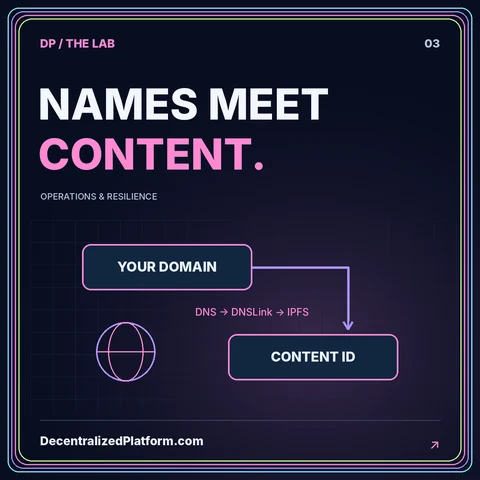
For IPFS, retain the complete release and verify its retrieval before updating the public name. For an ordinary static host, test deep links after upload. The IPFS publishing walkthrough and DNSLink guide cover these as separate steps.
Keep a previous known-good release until the rollback window closes. Do not let a cleanup task remove the only practical way to reverse an editorial or technical mistake. Publishing authority includes responsibility for retained history as well as the latest version.
Plan the handoff to another editor
Write down how to create an article, choose a category, add an image, preview the export, and request publication. Include a small example of a completed content record without including production credentials. A handoff should not require reconstructing undocumented habits from old messages.
Test the instructions with someone who did not build the workflow. Ask them to correct an excerpt and preview the result without touching the live publication. Note where they need additional context. Those gaps identify the next documentation improvements more reliably than an assumption that the interface is obvious.
Conclusion: make publishing repeatable
A good static CMS workflow produces a complete, reviewed, portable release. Model the content deliberately, separate editing from infrastructure authority, audit runtime dependencies, and validate the output rather than trusting an export button. Keep metadata and media under the same editorial controls as the article text.
Continue with the CMS webhosting guide and web hosting guide to select the delivery boundary. The result should be a publication another editor can maintain and another host can serve without reconstructing your original administrative environment.